By Abhishek Jagannathan, 2026 CLA Intern
I wrote my application for CLA almost 9 months (one whole child!) ago. One of the essays on the application asked for me to describe what made me interested in CAUSE. I wrote about the mock campaign project, working in government, and connecting my previous experience with new skills in these areas. I did not really write anything about the significance of CAUSE’s work in the API community, and what it meant for an organization like that to exist. It’s ironic, because that focus on API identity has been the most meaningful part of my CLA experience.
I’m a first generation Indian American. I grew up in Simi Valley, California - a city where a significant proportion of the academically inclined youth (the social bubble I most clearly fell into) were also first generation Indian American. On paper, I was fortunate enough to be surrounded by people who had similar backgrounds, creating a strong community in a predominantly white city.
But that wasn’t exactly my experience. Compared to my peers, my upbringing was relatively unorthodox. Although my parents only immigrated to the US in their mid-20s, they were both raised speaking English as a first language, and so I grew up never speaking any other language at all. My family is not religious in any traditional way. We never actively listened to Indian music, and I failed to develop any connection to Indian cinema. Even politically, I observed how my family did not align with most other families who were theoretically similar to us. From a young age, I felt that my only genuine connection to my cultural heritage was through the food my mother would cook, but even that has diminished in the last couple of years after moving to college.
So, while I ostensibly was ‘in community’ with a remarkably similar demographic cohort on paper, I actually found it very isolating. This was exacerbated significantly by a kind of purity culture that I am ‘less Indian’ because I was not raised with the typical influences. I was left with a complicated relationship to my cultural heritage - one that was technically accessible but felt largely foreign. If I struggled with claiming my identity as an Indian American, I certainly did not identify with API identity as a whole. From the attitudes I observed of those around me, Indians did not self-identify as Asian. Our history in this country, our cultural practices, the stereotypes we face, and the discrimination we receive are distinct. At times, I felt confused as to why we were politically grouped into a category that seemed too broad to be meaningful.
I think while applying for CAUSE, I still carried that skepticism with me. In my interview with Andrea and Nancy, I spoke of representation only in terms of other Indian Americans. When I was accepted into the cohort, I was surprised, and felt a great deal of imposter syndrome, which persisted through my first week in the program.
This changed for me on the Friday of the first week, during an activity about cultural heritage. We were provided with a timeline of API history in the US, and instructed to have conversations in small groups about what stuck out to us, and about the histories of our families. The resulting conversation was the first time I was able to effectively articulate my internal feelings of cultural ostracization, which in the moment felt like a big milestone. This activity is also where I learned why Indian Americans are part of the API community - because community leaders in the 1970s advocated for us to be included in the Asian American demographic politically so that we would receive civil rights protections. This information really resonated with me, because it was directly relatable to my own experience. I had applied to CLA strategically, knowing that despite my internal confusion, I objectively fell into the category CAUSE was catering to, and could benefit from it. In the same way, Indian Americans advocated to be considered Asian American strategically, knowing it would yield a political benefit. This connection helped me root my cultural identity in something I intuitively understood, and could relate to my present day life.
At the start of every CLA session, Rachel leads us in a grounding exercise. We take a deep breath, and think of four things we can see, three things we can touch, two things we can hear, and one word to describe how we feel. The idea is that this exercise roots us in space and in the present moment, before we proceed with our agenda for the day. I think that this practice shines through in all of CAUSE’s work.
Before CAUSE, my cultural identity felt very removed from the space I inhabited. From my observations, India’s cultural center is its pride in its history, the power it once held on the world stage, and the respect that legacy demands. But for me, this past is one that I could not interact with, and therefore I remained disconnected.
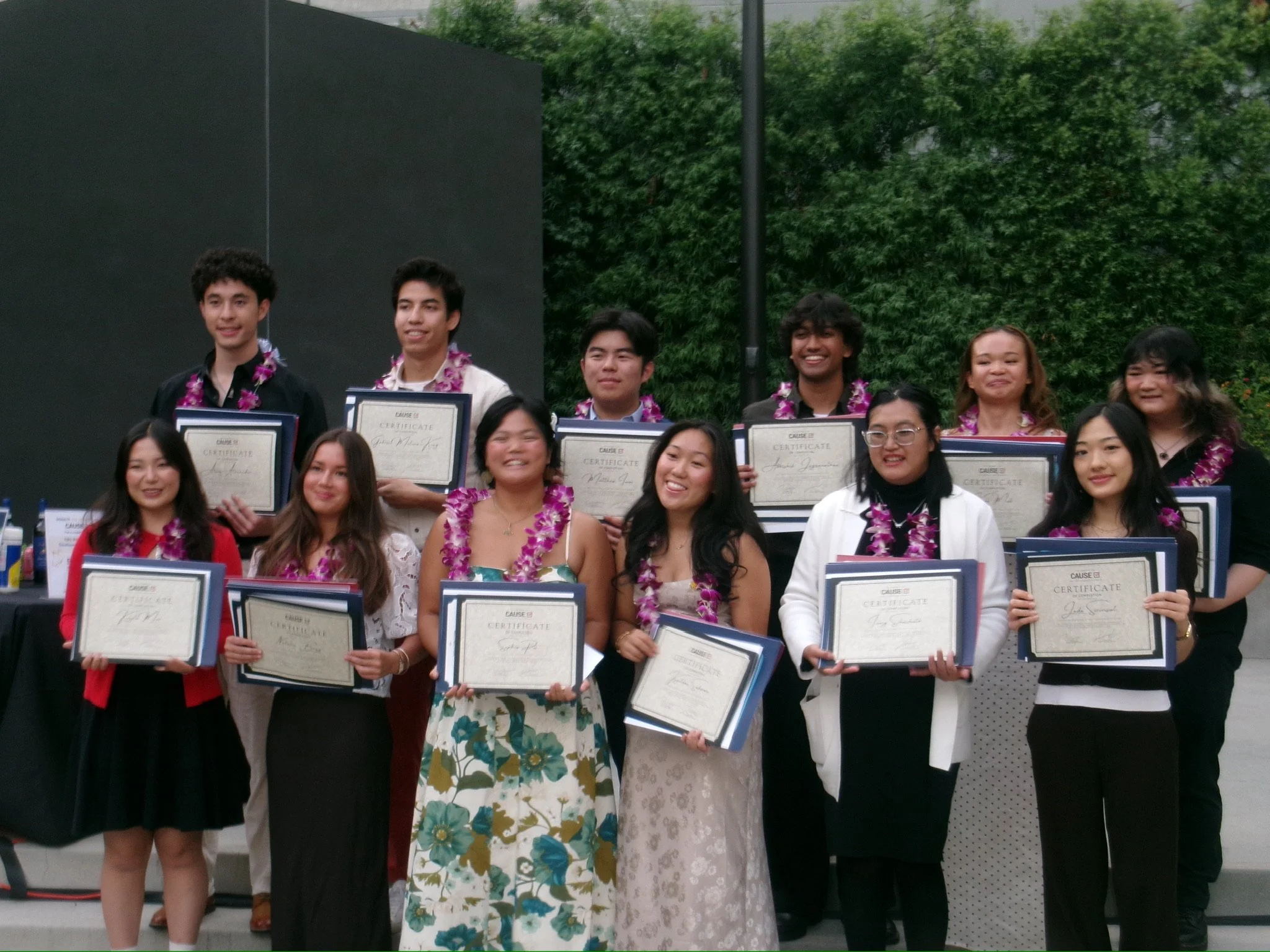
At CAUSE, everything we do for the API community is grounded in the present day. Our voter education efforts, our community outreach, these are about this moment in time that we inhabit and how we can work to shape the future for the good of our community. It is relatable and immediate. At an event like our end of summer soirée, the culture is all around us, rooted in political engagement and civic service, carried by conversations about our cohort’s success and our immediate futures. Consequently, it is a culture with which I feel not only comfortable, but proud to claim as a defining component of my own identity. I am eternally grateful to CAUSE, to Nancy, Andrea, and Rachel, and to my fellow cohort members for creating this space and making me feel at home in this community.