Gubernatorial

AJSOCAL and CAUSE Launch Statewide Initiative to Build Pipeline of AANHPI Leaders for Public Appointments

FOR IMMEDIATE RELEASE


For media inquiries contact: 

AJSOCAL  | (213) 977-7500 | communications@ajsocal.org

CAUSE | (213) 269-4639 | appointments@causeusa.org

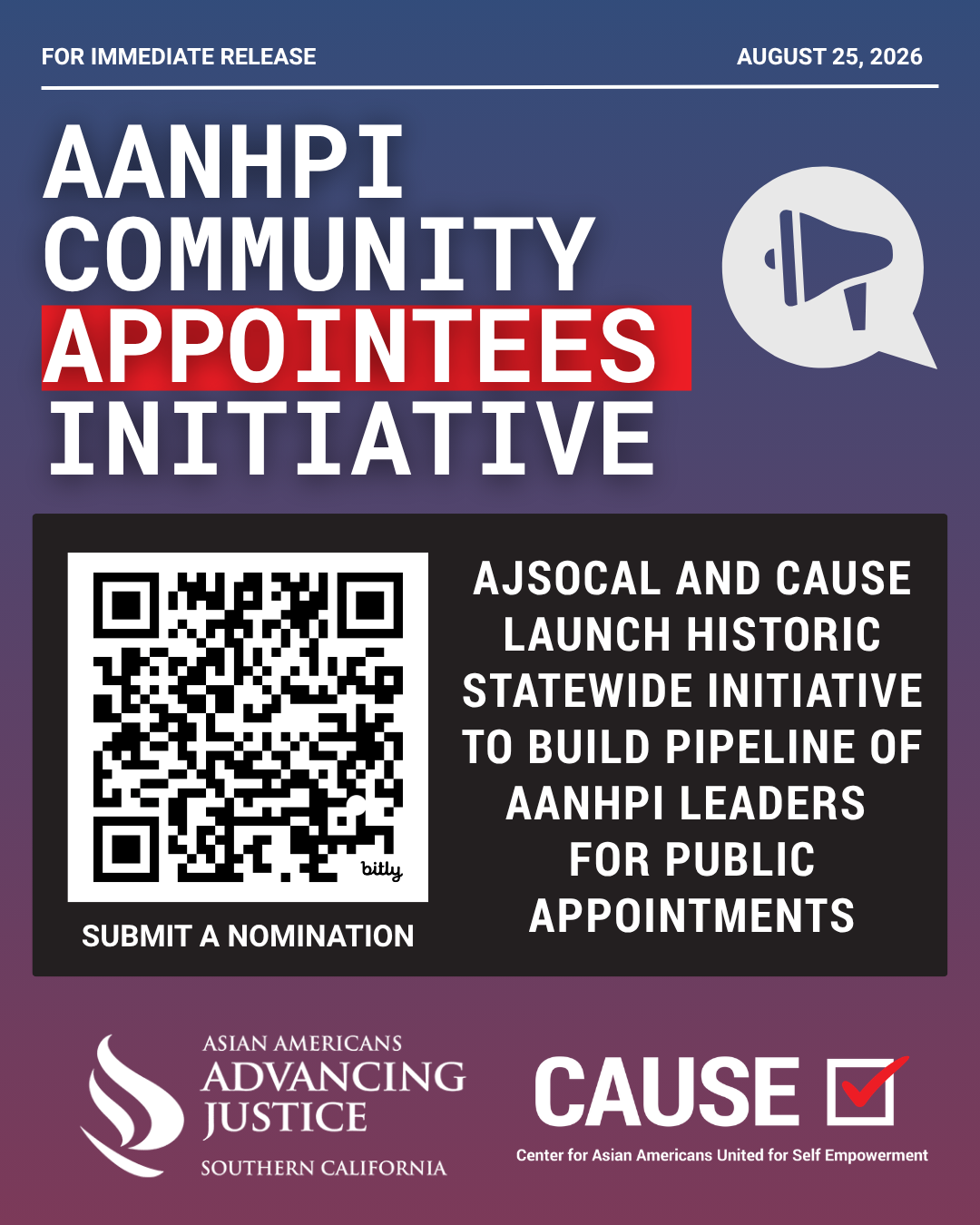
LOS ANGELES, CALIFORNIA  — Asian Americans Advancing Justice Southern California (AJSOCAL) and the Center for Asian Americans United for Self-Empowerment (CAUSE) announced the launch of the AANHPI Community Appointees Initiative, a joint effort to strengthen Asian American, Native Hawaiian, and Pacific Islander representation on government boards, commissions, task forces, and advisory bodies across California.

As California prepares for a new gubernatorial administration, the Initiative will identify and elevate qualified AANHPI leaders, build a statewide roster of prospective appointees, advocate for greater representation, and prepare leaders to serve in public decision-making roles.

Although AANHPI communities are among the fastest-growing populations in California, they remain underrepresented in many of the public bodies where decisions affecting their communities are made. That underrepresentation is compounded by the extraordinary diversity within AANHPI communities, which is too often overlooked. Ensuring representation across ethnicities, languages, geographies, generations, and lived experiences is critical to ensuring that AANHPI communities are not treated as a monolith. 

The Initiative builds on decades of advocacy, community organizing, civic engagement, and leadership development by AJSOCAL and CAUSE.

“CAUSE has long believed that civic leadership takes many forms,” said Nancy Yap, Executive Director of CAUSE. “Public appointments are important leadership roles that bring our communities’ voices to the table. Through this Initiative, we are creating stronger pathways for AANHPI leaders to serve and shape California’s future.”

“At a time when our communities are facing real threats to their visibility, safety, opportunity, and sense of belonging, AANHPI voices need to be present wherever decisions are being made. Building a strong pipeline of AANHPI leaders ready to serve is an important part of protecting our communities and strengthening their voice in California’s future,” said Dahni Tsuboi, CEO of AJSOCAL.

PROCESS & TIMELINE

Candidates will be identified through self-nominations and community nominations, followed by outreach, vetting, education, and relationship-building to prepare prospective appointees for public service opportunities. Nominations are accepted on a rolling basis. Candidates submitted by September 9, 2026, will be considered for the inaugural statewide roster, which is expected to launch on October 5, 2026. Additional nominations will continue to be accepted and reviewed for future appointment opportunities.

TIMELINE AT A GLANCE

  • Nominations: August 14 – September 9 

  • Contact & Outreach: August 17 – September 18 

  • Vetting: August 17 – September 18 

  • Education & Relationship Development: August 17 – Ongoing 

  • Confirmation: September 25 

  • Launch of Inaugural Roster: October 5

To submit a nomination, visit bit.ly/AANHPIappointmentsCA.

Established and emerging leaders across California are encouraged to nominate themselves, and community members and organizations are invited to nominate qualified leaders from their networks. Prior appointment experience is not required. For questions, contact appointments@causeusa.org.
###

ABOUT AJSOCAL:

Asian Americans Advancing Justice Southern California (AJSOCAL) is the nation’s largest civil rights and legal services organization that advocates for Asian Americans, Pacific Islanders, and other underserved communities. Through direct legal services, advocacy, education, and coalition-building, AJSOCAL aims to create a more just and inclusive society. Offices are located in downtown Los Angeles and Orange County, with a presence in Sacramento. Learn more at: www.ajsocal.org.

ABOUT CAUSE:

The Center for Asian Americans United for Self-Empowerment (CAUSE) is a nonpartisan, nonprofit organization founded in 1993 to advance the civic and political empowerment of Asian Pacific American communities. Through leadership development, voter education, and policy advocacy, CAUSE builds a more inclusive and representative democracy. Learn more at www.causeusa.org.

AANHPI Organizations Release Historic California Gubernatorial Forum Recording in 10 AANHPI Languages, Expanding Voter Access Across Diverse Communities

FOR IMMEDIATE RELEASE
MAY 13, 2026

CONTACT:

CAUSE / comms@causeusa.org / 213-260-1678  

KADC / kademcom@gmail.com 

Asian American, Native Hawaiian and Pacific Islander Organizations Across Southern California United to Share Information about Gubernatorial Candidates In-Language to Communities

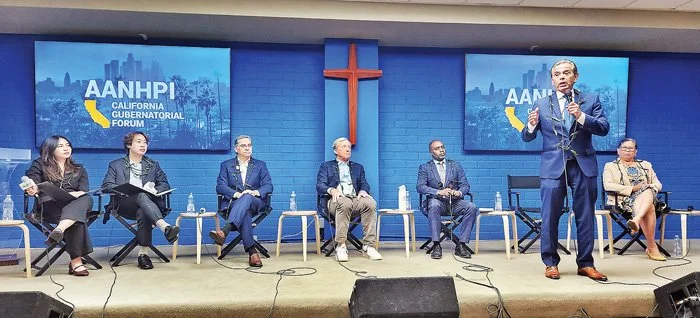
LOS ANGELES – On April 18, 2026, a coalition of 40+ leading Asian American, Native Hawaiian, and Pacific Islander (AANHPI) organizations from across Los Angeles County, led by the Korean American Democratic Committee (KADC) and Center for Asian Americans United for Self Empowerment (CAUSE), convened a historic California gubernatorial candidate forum in Los Angeles’ Koreatown, bringing together community members, leaders, and gubernatorial candidates for one of the largest multilingual AANHPI civic engagement efforts in California’s 2026 gubernatorial election cycle.

As the only gubernatorial forum in Los Angeles County hosted by and for AANHPI communities, the event created a powerful and unique opportunity for gubernatorial candidates to engage directly with one of California’s fastest-growing and most influential constituencies.

California is home to more than 7 million Asian Americans and Pacific Islanders and over 4 million eligible AANHPI voters, making multilingual voter engagement increasingly critical to statewide civic participation.

The event was intentionally not livestreamed so the full forum could be translated and shared across multiple AANHPI languages, ensuring broader and more equitable access for communities whose primary language is not English or who have limited English proficiency.

Rather than treating translation as an afterthought, organizers centered language accessibility as a core part of the forum’s design from the beginning. Through collaboration with more than 40 AANHPI organizations, the coalition worked to identify language gaps across communities, including languages that are often excluded from traditional outreach and civic engagement efforts.

The result is one of the most expansive multilingual releases of a California gubernatorial forum for AANHPI communities to date, with translated captions available in 10 AANHPI languages, alongside English and Spanish.

“Though we talk about voter engagement, especially about how to meaningfully engage communities of color, we often fail to identify and address the barriers that prevent full participation,” said Esther Lim, president of the Korean American Democratic Committee (KADC). “From the beginning, we knew one of the biggest barriers for many of our communities was language access. We wanted our families and limited English proficient community members to feel included in this election season and to know these conversations were for them too.”

In Los Angeles County, there are 13 threshold languages, but organizers also recognized that many AANHPI community languages are still not included within existing language access systems. Significant effort went into identifying additional language needs, particularly for Native Hawaiian and Pacific Islander communities, and determining how to address those gaps. In preparation for the forum, translators requested by the community in Korean and Tagalog were onsite with equipment, alongside AI-supported technology to assist with live translation during the event.

“One of the most powerful aspects of this effort was the breadth and diversity of the coalition behind it,” said Nancy Yap, Executive Director of the Center for Asian Americans United for Self Empowerment (CAUSE). “When we needed support identifying language gaps and translating the forum, our community partners stepped up immediately. Even within AANHPI communities, many people still do not have equitable access to civic information and language resources. We wanted this forum to reflect that everyone deserves access to these conversations and a voice in California’s future.”

The recordings with closed captions seven AANHPI languages as well as English and Spanish is available at: https://bit.ly/aanhpi-gubernatorial-forum-vid. Bengali, Hindi, and Punjabi are scheduled to be available Friday, May 22.    


Thank you to our community partner organizations for providing the translated captions: Simplified and Traditional Chinese (AJSOCAL); Korean (KADC); Thai (Thai Community Development Center); Tagalog (Pilipino Workers Center); Vietnamese (PIVOT), Samoan (Le Gafa) and Spanish. With additional languages coming soon: Bengali (SAN), Hindi (SAN), Punjabi (SAN).   

To view these translations on YouTube: click the CC button at the bottom of the video to turn captions on, then click the gear icon (Settings) → Subtitles/CC → and select your preferred language. The video also has timestamps so you can navigate between sections.

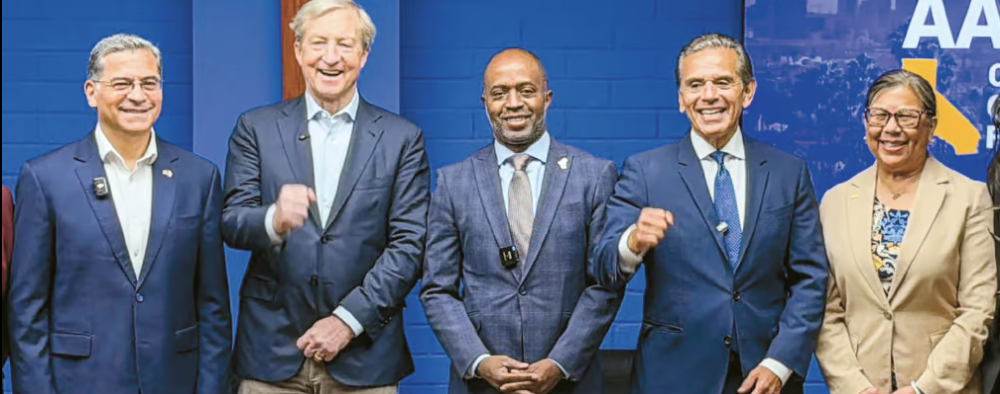
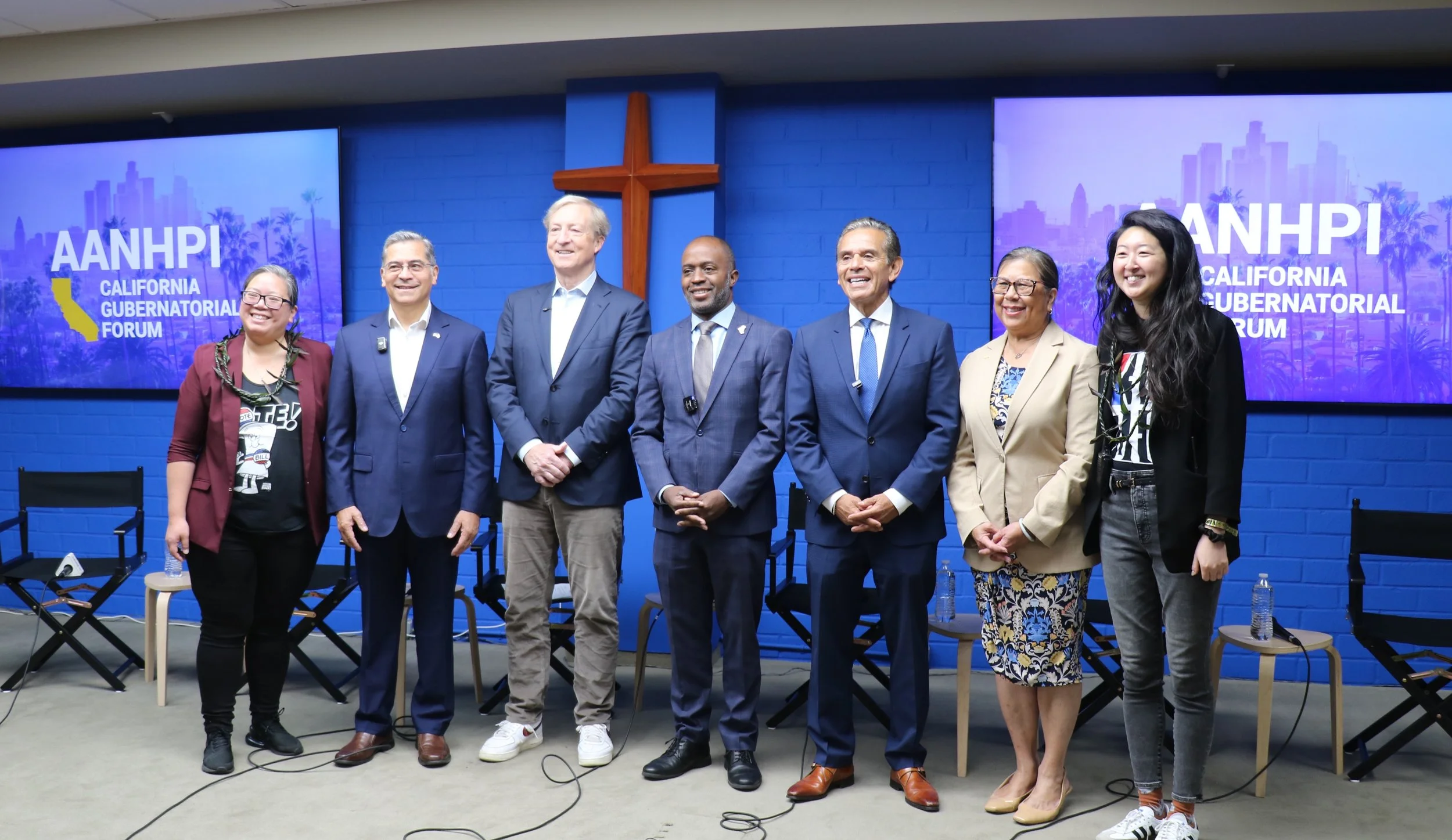
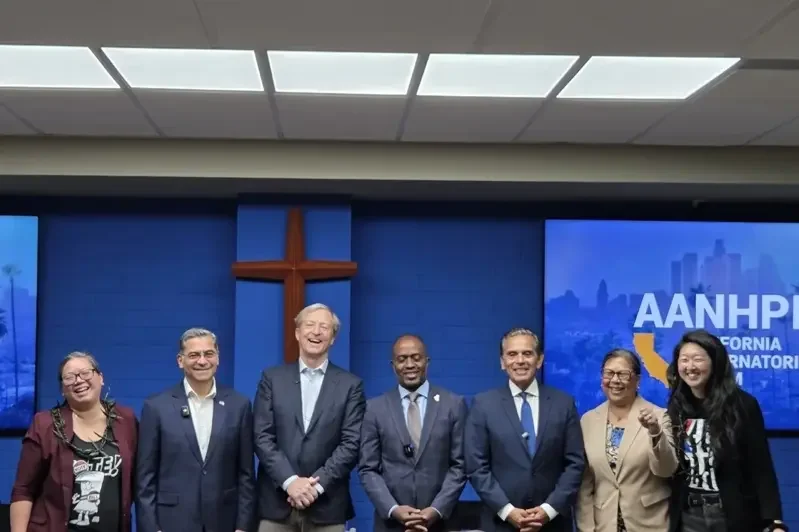
Gubernatorial candidates who participated included Xavier Becerra, Tom Steyer, Tony Thurmond, Antonio Villaraigosa and Betty Yee.  

Lastly, don’t forget to cast your ballot by June 2! Vote-by-mail ballots have already been sent, and in-person voting begins May 23 in Los Angeles County.

CAUSE is also gearing up for its 2026 Together We Vote campaign, a series of Get Out the Vote (GOTV) activations taking place across Los Angeles County during the 10-day early voting period. Together We Vote is designed to meet voters where they already gather, bringing civic engagement into trusted neighborhood spaces and cultural spaces across Los Angeles County. Events include Community Culture Day in the San Gabriel Valley at Blossom Market Hall, the CAUSEtheVOTE Community 5K Run/Walk at the Rose Bowl Loop, Jeepney to the Polls in Historic Filipinotown at Thunderbolt LA, and more! 

The official event calendar (May 23 – June 2) is now available on the CAUSE website, featuring all event locations and activities: https://www.causeusa.org/togetherwevote.


###


About Korean American Democrats

The Korean American Democratic Committee (KADC) is a political action committee based out of Los Angeles, California. KADC is a countywide Chartered Democratic Club under the Los Angeles County Democratic Party. Since its inception in 1992, KADC has mobilized the Korean American community to vote and participate in the local, state and federal electoral process. Please visit their website:  www.kademocrats.org

About Center for Asian Americans United for Self Empowerment (CAUSE)

The Center for Asian Americans United for Self-Empowerment (CAUSE) is a nonpartisan, nonprofit organization committed to advancing the civic and political empowerment of Asian and Pacific Islander communities. Since 1993, CAUSE has provided leadership development programs, civic education initiatives, and policy advocacy to build a stronger, more inclusive democracy. Learn more at www.causeusa.org.


Co-Hosting Organizations (40)

Korean American Democratic Committee (KADC); Center for Asian Americans United for Self Empowerment (CAUSE); Through Peace; World Mission University; AAPI Equity Alliance;  UCLA Asian American Studies Center’s Asian American Pacific Islander Policy Initiative; Loyola Marymount University (LMU) Bellarmine College of Liberal Arts Political Science and International Relations; Pilipino Workers Center (PWC); Asian Dems of Los Angeles; 'Ahahui Kīwila Hawaiʻi o San Diego; Asian Americans Advancing Justice Southern California (AJSOCAL); Asian American Media Alliance (AAMA); Asian Pacific American Bar Association of Los Angeles County (APABA); Asian Pacific Community Fund (APCF); Asian Pacific Islander Forward Movement; Cal State Los Angeles College of Ethnic Studies; Chinese American Citizens Alliance, Chinese American Museum; Daniel K. Inouye National Center for the Preservation of Democracy at the Japanese American National Museum (JANM); Empowering Pacific Islander Communities (EPIC); Faith And Community Empowerment (FACE); Hawaii's Daughters Guild of California; Khmer Girls in Action (KGA); Korean American Federation of Los Angeles (KAFLA); Leadership and Education through Gaagana Fa’asamoa (Le GaFa); Little Tokyo Community Council (LTCC); Little Tokyo Service Center (LTSC); Nikkei Progressives; OCA-Asian Pacific American Advocates of Greater Los Angeles; Orange County Asian and Pacific Islander Community Alliance (OCAPICA); Pacific Islander Collective San Diego (PICSD); Pacific Islander Health Partnership (PIHP); Pilipino American Los Angeles Democrats (PALAD); PIVOT: The Progressive Vietnamese American Organization; Search to Involve Pilipino Americans (SIPA); South Asian Network (SAN); Southeast Asia Resource Action Center (SEARAC); Southern California Pacific Islander Community Response Team (SoCal PICRT); Thai Community Development Center (Thai CDC); United Cambodian Community (UCC) and others.

亞太裔論壇五強交鋒 醫保移民政見分歧明顯 (WORLD JOURNAL)

記者張庭瑜/洛杉磯即時報導 2026-04-22 17:00 ET

隨著亞太裔選民影響力持續擴大,由40多個亞裔組織共同舉辦的加州州長候選人論壇,18日在洛杉磯世界宣教大學(World Mission University)舉行,多名主要參選人齊聚,凸顯AANHPI社群在州長選戰中的關鍵角色。

主辦方表示,這是洛杉磯縣唯一由亞裔組織專為社區舉辦的州長候選人論壇,受邀名單依據加州州務卿2月17日公布的募款總額前十發出。根據主辦方數據,加州目前有逾730萬亞裔美國人、夏威夷原住民與太平洋島民(AANHPI)居民,占全州人口逾15%,是過去十年增長最快族群之一,社區整體消費力達2兆美元,占加州選民近20%。

醫療保健議題引發最多分歧。億萬富翁斯泰爾(Tom Steyer)與加州教育廳長瑟蒙德(Tony Thurmond)均表態支持單一付款人健保制(Single-payer healthcare,全民醫保由單一公共機構支付),前者指出全球數據顯示,此制度費用約為現行體制一半,長遠而言別無選擇;後者強調任何有能力的雇主,都應提供員工醫療保障,並點名批評部分非營利醫療機構以鉅額盈餘投資傷害移民社區的體系。

前洛杉磯市長維拉萊構沙(Antonio Villaraigosa)以財政現實為由,持保留立場,他指加州預算赤字嚴峻,耗資逾5000億元的單一付款人計畫難以落實,主張以公共保險選項作為過渡。前加州檢察長貝西拉(Xavier Becerra)承諾加州將成為聯邦削減醫療保障後的最後防線,並擴充社區衛生中心及居家照護資源;前加州審計長余淑婷(Betty Yee)則提出恢復白卡(Medi-Cal)獨立稽查機制,清查虛假申報,同時擴充醫療人力,縮小族裔照護落差。

移民議題上,五位候選人一致批評移民與海關執法局(ICE)現行執法方式。斯泰爾與瑟蒙德均主張擴大法律援助基金及移民「知你權利」宣導;斯泰爾並指應以種族歸納為由,對ICE提起檢控。貝西拉回顧其擔任加州檢察長及聯邦衛生部長期間,曾就DACA及人口普查計算方式兩度向最高法院提告川普並勝訴,強調加州有能力以法律途徑對抗違憲的聯邦執法行動。維拉萊構沙指出ICE執法行動不成比例針對西裔與亞裔;余淑婷則將語言障礙定義為貫穿移民議題的根本困境,主張由社區組織主導政策落地執行。

加州州長選戰攻防 5大候選人同台激辯這些議題 (WORLD JOURNAL)

記者張庭瑜/洛杉磯即時報導 2026-04-22 18:04 ET


由40多個亞裔美國人、夏威夷原住民與太平洋島民(AANHPI)組織共同舉辦的加州州長候選人論壇,18日在洛杉磯世界宣教大學舉行,前加州檢察長貝西拉(Xavier Becerra)、民主黨籍億萬富翁斯泰爾(Tom Steyer)、加州教育廳長瑟蒙德(Tony Thurmond)、前洛杉磯市長維拉萊構沙(Antonio Villaraigosa)及前加州審計長余淑婷(Betty Yee)出席,就住房負擔、環境正義、投票權及小企業等議題各抒己見。


住房負擔方面,五位候選人均承諾大幅增加住宅供給並削減行政障礙。斯泰爾提出將租金列為可抵稅項目,並對租金急漲設限;貝西拉承諾,就任後將宣布100日緊急狀態、凍結房屋保險及電費漲幅,同時擴大首購族頭期款補助;余淑婷主張恢復重建機制,推動舊區翻新及適應性再利用;瑟蒙德提出利用各縣閒置公有土地興建200萬住宅單位;維拉萊構沙則以其任期內將洛杉磯市中心住宅單位從2萬增至6萬為佐證,說明其有能力增加住房供給。

環境正義議題上,多位候選人均指出高速路及廢棄物設施長期集中於弱勢社區。貝西拉表示,他擔任加州檢察長時,曾設立環境正義局;任聯邦衛生部長時,成立氣候變遷與健康平等部門;斯泰爾強調污染者付費原則,並主張三倍電動車稅抵免加速潔淨能源普及;維拉萊構沙提及市長任內推動港口減排及全市植樹計畫,優先選址有色族裔社區;余淑婷指出州府氣候韌性資金流向少數族裔社區的比例長期偏低,承諾以此為核心施政方向。


投票權方面,各候選人均對聯邦層面壓制選民的趨勢表示高度警惕。維拉萊構沙強調其自青年起即投身公民運動,主張州長帶頭建立廣泛選民保護聯盟;瑟蒙德承諾以州府資金資助非營利組織培訓多語言選民教育人員;余淑婷提出以家庭聚會形式傳遞投票資訊,貼近社區生活實際;斯泰爾則警告ICE可能干預選舉,強調必須有組織地加以應對。


小企業議題上,維拉萊構沙直言加州是全美最難做生意的州,批評「私人檢察長法(PAGA,授權員工代表政府對雇主提起違反勞動法訴訟)」對小企業造成沉重負擔;斯泰爾強調非英語系移民企業主難以取得一般商業融資,而其非營利社區銀行已累計提供數十億元貸款;貝西拉批評聯邦小企業署近期拒絕移民企業主申請貸款,承諾提供一站式申辦服務;余淑婷則提醒眾多AANHPI企業利潤空間極薄,必須正視關稅及供應鏈動盪的外部衝擊。


共和黨選民方面,獲川普總統表態支持的前福斯新聞主播希爾頓(Hilton)支持率最高,達到為45%,希爾頓未參加本次辯論。

Where California Governor Candidates Stand: AANHPI Forum Highlights Policy Differences in Crowded Primary (Asian Journal News)

Asian Journal Newsroom

April 22, 2026

Democratic contenders outline positions on affordability, housing, and governance as polling shows a divided field and 23% of voters still undecided.

LOS ANGELES (April 22, 2026) — A gubernatorial forum held April 18 at World Mission University offered one of the clearest side-by-side comparisons of policy positions in California’s 2026 governor’s race. Five Democratic candidates addressed targeted inquiries from a coalition of Asian American, Native Hawaiian, and Pacific Islander (AANHPI) organizations. This demographic now represents 20% of the California electorate and generates over $200 billion in annual economic activity.

Organized by the Center for Asian Americans United for Self Empowerment (CAUSE) and the Korean American Democratic Committee (KADC), the event utilized a rigorous format. Questions were developed by 40 civic groups with strictly timed 90-second responses. This approach prioritized policy granularity over campaign rhetoric.

While Xavier Becerra, Tom Steyer, Antonio Villaraigosa, Tony Thurmond, and Betty Yee participated, the event was marked by the absence of fellow Democrats Katie Porter and Matt Mahan. Republican frontrunners Steve Hilton and Chad Bianco also did not attend.

The Polling Landscape: Volatility and Late-Stage Movement

The forum took place against a backdrop of significant electoral flux. Recent data from Emerson College Polling places Republican Steve Hilton at 17% and Riverside County Sheriff Chad Bianco at 14% statewide.

Among Democrats, support remains fragmented but is beginning to coalesce following the withdrawal of Representative Eric Swalwell. Tom Steyer currently holds 14%. Xavier Becerra has seen a strategic rise to approximately 13% in internal tracking by the California Democratic Party. With 23% of voters still undecided, the state’s top-two primary system – where the two highest vote-getters advance regardless of party – places added importance on late-stage voter engagement to avoid a Democratic lockout.

Contrasting Governing Models

The candidates’ responses revealed distinct philosophies on managing the world’s fifth-largest economy.

Xavier Becerra: The Defensive Shield

Becerra has transitioned his pitch from federal collaborator to state protector. During the forum, he spoke about his tenure leading the White House Initiative on Asian Americans, Native Hawaiians, and Pacific Islanders (WHIAANHPI) while serving as the U.S. Secretary of Health and Human Services. This initiative has since been deactivated by the current federal administration.

  • The Federal Void: Becerra argued that California must build parallel systems to replace lost federal outreach. He proposed a state-level AANHPI initiative to ensure linguistic and cultural access to government services.

  • Utility Emergency: He pledged to declare a state of emergency on utility costs within 120 days, using executive authority to freeze rate hikes.

  • Governing Approach: Aggressive state action through enforcement and litigation to preserve civil rights and health equity.

Tom Steyer: The Structural Disruptor

Steyer positioned himself as an independent candidate capable of challenging corporate power structures. He framed his platform around systemic changes to address high costs of living.

  • Tax Reform for Renters: Steyer proposed a policy to make residential rent tax-deductible, providing parity between renters and homeowners.

  • The AI Compute Fee: He called for a tax on processing power used by large-scale AI companies, with revenue funding a “Worker Transition Fund” for those displaced by automation.

  • Governing Approach: Structural economic reform aimed at reducing long-term costs by shifting the tax burden toward large tech and utility monopolies.

Antonio Villaraigosa: The Executive Builder

Villaraigosa is running as a pragmatic coalition builder focused on infrastructure and tangible results. He pushed back against the idea that the state can litigate its way to prosperity.

  • Supply-Side Housing: He argued that affordability requires massive production. He pledged to use executive orders to bypass local zoning hurdles for high-density housing near transit hubs.

  • Public Safety Focus: Highlighting his record in Los Angeles, he proposed a statewide surge in funding for community policing and anti-retail-theft task forces.

  • The One-Term Pledge: He reiterated that he would not seek reelection, claiming this freedom allows him to make hard choices regarding homelessness and state spending.

  • Governing Approach: Executive-led production and public safety reform through streamlined permitting and local government accountability.

Tony Thurmond: The Social Investor

Thurmond’s platform centers on the idea that economic strength depends on the social safety net and education system.

  • The 2-Million Home Mandate: Thurmond proposed building two million homes on surplus government-owned land, using state-issued bonds to lower construction costs.

  • Small Business Micro-Grants: He advocated for a $500 million state fund for micro-grants for legacy businesses in cultural enclaves to prevent displacement.

  • Cradle-to-Career Access: He focused on expanding vocational training, specifically targeting under-represented groups in computer science, such as Pacific Islander students who currently have an enrollment ratio of 0.69.

  • Governing Approach: Direct state investment in housing and human capital to drive long-term economic stability.

The Withdrawal of Betty Yee

Betty Yee, the former California State Controller and a longtime leader within the AANHPI community, was a central participant in the April 18 forum. However, on April 20, just two days after the event, Yee officially suspended her campaign for governor.

As State Controller from 2015 to 2023, Yee was the state’s chief fiscal officer, known for her rigorous audits and focus on taxpayer accountability. She entered the race as a prominent AANHPI voice, emphasizing fiscal responsibility and social equity.

Yee cited insurmountable fundraising challenges as the primary reason for her withdrawal. In her announcement, she noted that the high cost of media in a statewide race, combined with a fragmented Democratic field, made it impossible to sustain a viable path to the June primary. While she has ceased all campaign activities, her name will remain on the ballot.

Strategic Implications for the June 2 Primary

The forum clarified that while candidates share broad priorities, their execution strategies differ materially. With ballots set to be distributed in early May, the race remains unsettled. In a fragmented field, direct engagement with organized constituencies – particularly those with growing electoral influence like the AANHPI community -may play a decisive role in determining which candidates advance to the general election.

California Gubernatorial Candidates Court API Voters (AMERICAN COMMUNITY MEDIA)

BY NICOLE CHANG

Apr 21, 2026

LOS ANGELES — Democratic candidates in California’s June 2 gubernatorial primary are stepping up efforts to court Asian American, Native Hawaiian, and Pacific Islander (AANHPI) voters, outlining policy proposals on the cost of living, health care and housing at a recent forum in Koreatown.

Xavier Becerra, Tom Steyer, Tony Thurmond, Antonio Villaraigosa and Betty Yee spoke April 18 at World Mission University, presenting plans on a range of issues including health care, housing, small business, immigration, the environment and voting rights, with a focus on the state’s affordability crisis.

The forum was co-hosted by the Korean American Democratic Committee (KADC) and CAUSE (Center for Asian Americans United for Self-Empowerment), with more than 40 API community organizations participating.

The event was structured as a policy forum rather than a debate. Candidates responded to pre-selected questions in turn. It was moderated by Nathan Chan, a professor at Loyola Marymount University, and Andrea Mac, a programs manager at CAUSE. Community representatives from Vietnamese, Thai and Indian organizations, along with small business owner James Choi of Cafe Dulce, posed questions.

Affordability, health care among top priorities

Steyer, a businessman and a philanthropist, said “Californians can no longer afford to live here,” making cost reduction across the board his top priority. Steyer is currently leading among Democratic candidates by a narrow margin in a recent Emerson College poll.

He pointed to health care costs as a central issue and strongly backed a single-payer system. He also argued that high operating costs — not just regulation — are the main burden on small businesses, proposing rent tax relief, electricity market reforms and a windfall profits tax on oil companies to ease financial pressure.

Becerra, former U.S. Secretary of Health and Human Services and California attorney general, emphasized his experience implementing policy. He proposed expanding community health centers and strengthening public programs to gradually improve access to care. He also called for a “one-stop” system to simplify government services for small businesses, along with increased housing supply and expanded down payment assistance.

Thurmond, California’s superintendent of public instruction, highlighted his upbringing in an immigrant family and pledged to focus on working families. He supports a single-payer health care system, middle-class tax credits and expanded access to low-interest loans to reduce financial strain on small business owners.

Villaraigosa, a former Los Angeles mayor, pointed to his record expanding housing, reducing violent crime, improving public school outcomes and advancing environmental initiatives. He advocated for regulatory reform and streamlined permitting to boost the economy, while cracking down on health care fraud to reduce waste. “I’m not just an administrator — I’m a coalition builder,” he said, pledging to lead an inclusive, multiracial state government.

Yee withdraws

Yee was the only Asian American candidate in the race until she announced her withdrawal April 20. She drew on her experience growing up in a family that ran a small laundry business. She emphasized the challenges facing immigrant-owned businesses and called for policies that address both regulatory burdens and global economic pressures such as supply chains and tariffs. 

Yee also identified inefficiencies and fraud in Medi-Cal as key issues and stressed the need to improve language access, calling it “the most persistent barrier across generations.” She proposed expanding multilingual services and diversifying the health care workforce.

April is National Language Access month aimed at promoting awareness of language access rights in public services. 

The power of the API vote

Esther Lim, president of KADC, said the forum was intended to help API voters better understand key policies and make their voices heard. 

Lim said the forum will be released online with multilingual subtitles, aiming to expand civic engagement among API voters.

Nancy Yap, executive director of CAUSE, said API communities are a vital and fast-growing constituency in California. “This forum was an opportunity to show that we are here, engaged and paying attention,” she said.

According to Yap, about 7.5 million Asian Americans and Pacific Islanders live in California, making up more than 16% of the state’s population. More than 4 million are registered voters, and API-owned businesses number about 750,000, supporting over 2.5 million jobs and generating roughly $193 billion in economic activity.

Race still a toss up

The race to replace outgoing Governor Gavin Newsom was shaken after allegations of sexual abuse by Democratic frontrunner and now former U.S. Representative Eric Swallwell, who has since withdrawn from the race and resigned from his position. 

Reporting shows Becerra surging ahead in the wake of Swalwell’s exit, moving from just 4% support on April 5 to 13%, leading other Democratic candidates, according to the Democratic Party’s most recent tracking poll. 

With six Democrats still in the running, the two Republican candidates remain at the top of most polls. 

A recent Emerson College Polling/Inside California Politics survey found Republican Steve Hilton — a former FOX News host and Trump-endorsed candidate — leading with 17%, followed by Republican Chad Bianco and Steyer at 14% each.

*Note: An earlier version of this story misspelled the name of the Korean American Democratic Committee President. Her correct name is Esther Lim.

This article is also posted on:

https://wavepublication.com/california-gubernatorial-candidates-court-asian-voters/

https://lapost.us/?p=80177

加州州長參選人論壇 聚焦亞太裔社區核心關切 (Phoenix TV)

凤凰卫视美洲台
加州州長參選人論壇 聚焦亞太裔社區核心關切

4/20/26

주지사 후보들 한인 등 아태계 표심잡기 경쟁 (KOREATIMES)

댓글 2026-04-20 (월) 12:00:00 한형석 기자

▶  LA 한인타운 정책 토론회 현장 중계

▶ 스타이어·베세라·서먼드·비야라이고사·베티 이
▶ 주거비·의료비·이민정책 등 현안 놓고 정책 대결
▶ 아태계 유권자 20% 육박… 선거 판세 ‘핵심 변수’

오는 6월2일 실시되는 캘리포니아 주지사 예비선거를 앞두고 차기 주지사 자리를 노리는 민주당 주요 후보 5인이 LA 한인타운에서 열린 포럼에서 아시아·태평양계 유권자들의 표심 잡기에 나섰다.

지난 18일 한인타운 내 월드미션 대학교에서 포럼 형식의 아시아·태평양계 커뮤니티 주지사 후보 정책 토론회가 개최됐다. 이번 행사는 한인민주당협회(KADC)와 아시안정치력신장연합(CAUSE)을 필두로 한 40개의 커뮤니티 단체가 공동 주최한 자리였다.

이날 포럼에는 탐 스타이어, 하비어 베세라, 토니 서먼드, 안토니오 비야라이고사, 베티 이 등 5명의 후보가 참석해 한인 등 아시아계 유권자들 및 커뮤니티 단체 관계자들과 소통했다.

이날 포럼의 질문은 행사에 앞서 설문조사를 통해 선정된 핵심 현안으로 구성됐다. 각 후보는 무작위 순서로 발언권을 얻었으며, 주거비 및 의료비 상승, 임금 문제, 이민 정책 등 커뮤니티의 절박한 문제들에 대해 답변하는 방식으로 진행됐다. 포럼에 참석한 5인의 후보는 각기 다른 배경과 강점을 내세우며 비전을 제시했다.

최근 여론조사에서 근소한 차이로 민주당 선두를 달리는 것으로 나타난 톰 스타이어 후보는 억만장자 투자 사업가 출신이며 환경 운동도 해왔다. 공직 경험은 없지만 경제 개혁을 중심으로 주지사 캠페인을 구축해 온 스타이어는 이날 포럼에서 특히 세입자의 렌트비 소득 공제 추진과 전기 독점 폐지, 단일 지불자 건강보험 도입 등을 주요 공약으로 강조했다.

연방 보건복지부 장관 및 캘리포니아 주 법무장관을 역임했던 하비어 베세라 후보는 자신의 공직 경험을 강조하며, 특히 취임 후 치솟는 공공요금에 대한 비상사태를 선포하고 노동자 권익 보호를 위한 법 집행을 강화하겠다고 약속했다.

2018년부터 캘리포니아주 교육감을 맡고 있는 토니 서먼드 후보는 과거 저소득 노동자였던 자신의 경험을 바탕으로 경제 공약을 설명하며 현 연방 정부와의 차별점을 부각했다. 그는 트럼프 행정부의 부유층 감세에 맞서 개스값과 식료품비 구제책을 마련하겠다고 밝혔다.

과거 LA 시장을 지냈던 안토니오 비야라이고사 후보는 특히 LA 시장 시절 다운타운 주택 공급을 3배로 늘린 실적을 강조하며, 규제 개혁을 통한 주택 공급 대거 확대를 주거 위기 해결의 핵심으로 꼽기도 했다.

캘리포니아 주 회계감사관을 지냈던 베티 이 후보는 주 정부의 예산 낭비를 막고 임금 착취를 강력히 단속하겠다고 밝히는 한편, 폐지된 재개발 프로그램을 부활시켜 적정가 주택 공급을 확대하겠다는 계획을 발표했다.

한 조사에 따르면 아시아태평양계는 캘리포니아 인구의 15% 이상(약 730만 명)을 차지하며 주 전체 유권자의 20%에 육박한다. 아시아태평양계 소유 기업은 캘리포니아 전체 기업의 약 25%에 달하며, 연간 2,000억 달러 이상의 경제적 가치를 창출하고 있다. KADC 측은 “단순히 유권자가 아니라 이 사회의 리더이자 경제의 주체”라며, “우리의 목소리를 보장할 후보가 필요하다”고 강조했다.

<한형석 기자>

[CA] 캘리포니아 주지사 선거 앞두고 AANHPI 단체들, 대규모 후보 포럼 개최 (KCMUSA)

KCMUSA | 2026-04-20 | 조회수 : 87회

“우리는 여기 있고, 우리는 중요하다”… 아태계 커뮤니티 정치 참여 강화

2026 캘리포니아 주지사 선거를 앞두고 아시아·태평양계(AANHPI) 단체들이 대규모 비정파적 교육 포럼을 열었다. 한미민주당협회(KADC)와 CAUSE를 중심으로 40여 개 AANHPI 단체가 공동 주최한 이번 행사는 4월 18일(토) 한국타운 월드 미션 대학교에서 열렸으며, 주요 민주당 후보들이 직접 참석해 커뮤니티와 대화했다.

포럼에는 베티 이(Betty Yee, 전 주 감사원장), 안토니오 비야라이고사(Antonio Villaraigosa, 전 LA 시장·하원의장), 톰 스타이어(Tom Steyer, 기업가·환경 활동가), 하비에르 베세라(Xavier Becerra, 전 연방 보건복지부 장관·주 검찰총장), 토니 서먼(Tony Thurmond, 주 교육감) 등 5명의 민주당 주지사 후보가 참석했다.

행사 주최 측은 “이 포럼은 단순한 후보 검증이 아니라, 캘리포니아 인구의 16% 이상을 차지하는 AANHPI 커뮤니티가 주 정부 의사결정 과정에 실질적으로 참여하고, 우리의 가치를 정책에 반영하기 위한 소통의 장”이라고 강조했다. KADC의 에스터 회장은 “1992 LA 폭동 이후 한국계 정치 역량 강화를 목표로 설립된 KADC가 코리아타운에서 이 행사를 개최한 것은 의미가 크다”며 “우리는 여기 있고(We belong), 우리는 중요하다(We matter)”는 메시지를 전했다.

CAUSE의 낸시 얍 전무이사는 “아태계는 캘리포니아 경제의 핵심으로, 75만 개 이상의 사업체를 운영하며 250만 개 일자리를 창출하고 있다”며 “그러나 우리는 여전히 소득 격차가 크고, 정치적으로 충분히 접촉받지 못하고 있다”고 지적했다. 참석 후보들에게는 퍼시픽 아일랜드 문화에 따라 환영의 의미를 담은 lei(레이)가 증정됐다.

후보들, 배경과 비전 밝혀

각 후보는 2분 개회사에서 자신의 성장 배경과 정책 철학을 밝혔다.

베티 이는 중국 이민자 부모 슬하에서 세탁소를 운영하며 자란 경험을 언급하며 “모델 소수민족 신화 뒤에 숨겨진 우리 커뮤니티의 고통을 드러내고 해결하겠다”고 말했다.

안토니오 비야라이고사는 LA 시장 재임 시 70% 유색인종 인사 임명, 범죄 감소, 졸업률 향상 실적을 강조하며 “연대와 단합의 리더십이 필요하다”고 역설했다.

톰 스타이어는 “캘리포니아에서 더 이상 살 수 없을 정도로 생활비가 높다”며 노동자와 소상공인 중심의 비용 절감 정책을 최우선 과제로 제시했다.

하비에르 베세라는 ACA와 DACA 수호, 트럼프 행정부 소송 경험을 바탕으로 “위기 대응 경험이 풍부한 리더가 필요하다”고 강조했다.

토니 서먼은 빈곤 가정 출신 경험과 민족 연구 의무화, ICE 학교·병원 출입 금지 법안 등을 소개하며 “더 나은 캘리포니아를 함께 건설하자”고 호소했다.

환경·투표권·소상공인·생활비·의료·이민·대표성 등 6대 주제 집중 논의

포럼은 환경, 투표권 확대, 소상공인 지원, 생활비 및 경제, 의료 서비스, 이민자 보호, 리더십과 대표성 등 6개 핵심 주제로 구성됐다. 각 주제별로 AANHPI 커뮤니티 리더들이 질문을 던지고, 후보들은 90초씩 답변했다.

후보들은 대체로 환경 정의(Environmental Justice) 강화, 언어 접근성 확대를 통한 투표권 보호, 소상공인 규제 완화와 자본 지원, 주택 공급 확대와 렌트 통제, 단일보험제(Single-Payer) 또는 공공 옵션 도입, ICE 대응 강화, AANHPI 커뮤니티의 위원회·기관 임명 확대 등에 의견을 모았다.

특히 생활비·의료·이민 분야에서는 트럼프 행정부의 예산 삭감과 반이민 정책에 대한 공동 대응 필요성이 강조됐으며, 후보들은 “커뮤니티를 직접 찾아가고, 신뢰할 수 있는 메시지를 통해 소통하겠다”는 약속을 잇따라 내놓았다.

“단순한 행사가 아닌, 지속적 파트너십의 시작”

사회를 맡은 안드레아 맥과 제이슨 찬 교수는 “이번 포럼은 AANHPI 커뮤니티가 캘리포니아의 미래를 함께 설계하는 주체임을 보여주는 자리”라고 평가했다. 행사는 녹화·다국어 번역되어 더 넓은 커뮤니티에 공유될 예정이다.

주최 측은 “이 포럼이 끝이 아니라 시작”이라며, 선거 기간 동안 AANHPI 커뮤니티와 후보들 간 지속적인 대화와 정책 반영을 이어가겠다고 밝혔다.

2026 캘리포니아 주지사 선거는 민주당 후보 경선이 치열하게 전개되고 있으며, AANHPI 유권자(약 450만 명 이상)의 영향력이 점차 커지고 있다. 이번 포럼은 아태계가 캘리포니아 정치에서 ‘목소리’를 넘어 ‘주역’으로 부상하고 있음을 상징적으로 보여준 행사로 평가된다

亚太裔40余机构共同举办加州州长候选人论坛提升社区声音 (US china press)

时间: 2026-04-20

【侨报讯】4月18日,5位民主党籍加州州长候选人应邀出席了在洛杉矶韩国城举办的州长候选人论坛,与亚太裔社区领袖及部分选民对话,回应选民关切的议题。此次论坛是由韩裔民主党委员会(KADC)、亚美政联(CAUSE)领衔,与洛杉矶县40个亚裔、夏威原住民及太平洋岛原住民(AANHPI)机构组成的联盟共同举办的。论坛规模空前,被认为是亚太裔参政史上具有历史意义的一次参政活动。

5位州长候选人与举办论坛方的代表在论坛开始前合影。侨报记者陈秋摄

出席当天论坛的候选人哈维尔·贝塞拉(Xavier Becerra)、汤姆·斯泰尔(Tom Steyer)、托尼·瑟蒙德(Tony Thurmond)、安东尼奥·威拉莱格沙(Antonio Villaraigosa)、余淑婷(Betty Yee)就加州的未来以及候选人当选州长后将如何支持亚太裔的发展等议题做出了回应。论坛上,社区领袖与5位候选人就社区关注的议题,包括环境、生活成本与经济,以及移民等问题进行了对话。

针对生活成本不断上扬居民在加州生活不起的问题,贝塞拉说,若他当选则会在“上任后的头120天内,将针对不断上涨的水电煤气费率宣布紧急状态。”贝塞拉曾任加州总检察长,后被总统拜登任命为联邦卫生与公众服务部部长。

自称是5位候选人中唯一商人的斯泰尔则表示,“我会让房租像抵押贷款利息一样可以抵扣税款。”斯泰尔是位亿万富翁和慈善家,是这5位候选人中从未担任过公职候选人,他“支持取消电力垄断权,也支持全民医保。”

这5名候选人中的唯一亚裔候选人余淑婷在论坛上谈及了加州的住房危机,呼吁恢复加州的“重新开发计划”(Redevelopment Program),“它能扩大我们的建筑能力。”这位前加州主计长指出,加州未能充分执行劳动法,导致工资盗窃行为基本上未受监管。她指出,“雇主之所以能逍遥法外,是因为他们知道加州政府并未在监管,而等到要采取法律手段时,工资早就没了。”

现任加州公共教育总监瑟蒙德表示,若当选他将为所有加州人减免日益上涨的汽油和食品价格负担。瑟蒙德是加州历史上第二位担任公共教育总监的非裔,在竞选活动中他经常强调自己出身贫寒、依靠公共救助成长的经历。他在论坛上概述了一项提案,核心是将政府拥有的剩余土地转化为住宅开发用地,计划利用现有的剩余土地,在加州建造200万套房产。

前洛杉矶市长威拉莱格沙说,“如果你想解决住房危机,你就必须建造更多房屋。”他表示,在他任洛杉矶市长期间,市中心住房的显著增长,这是他的政绩。若当选州长,他也能在加州的住房建设上有所作为。他说,“当我任市长时,洛杉矶市中心有2万套住宅。到我离任时,这个数字增加到了6万套。”

韩裔民主党委员会主席Esther Lim表示,“加州的亚裔、夏威原住民及太平洋岛原住民(AANHPI)居民是选民、工人、企业主与领导者。我们属于这里,我们的影响力至关重要。我们选出的州长必须确保我们在决策桌上拥有一席之地。”她说,“通过具有实质意义的包容和代表性来实现真诚互动,有助于弥合机构间的信任鸿沟,并提升公民的参与度。”

亚美政联执行主任Nancy Yap说,“加州的亚裔、夏威原住民及太平洋岛原住民的声音必须在影响我们生活的决策中得到倾听和体现,如果我们想推进AANHPI社区的公平与代表权,这种外延服务、社区组织与互动正是达到目的的方式。”

亚美政联主席胡泽群受访时表示,“他们当中每一位都有机会成为下一位州长,而我们亚太裔社区有18%的加州有资格投票的选民,作为一个整体,我们可以做出改变。现在是时候关注每一位候选人了,我们投出的票对于我们社区的未来很重要,对于加州的未来也很重要。”

参与举办此次论坛的亚太裔社区基金会执行长黄群雁受访时呼吁亚太裔积极参与,选自己理想的候选人。她说,“只有我们积极参与让人知道我们关心政治,这些候选人才能到社区来听我们讲话。”她表示,举办此次论坛即是要让这些候选人了解亚太裔所关心的话题,若当选他们也能得当地处理亚太裔社区的问题。

当天参与论坛的候选人问答录像将于2026年5月4日前在CAUSE网站上发布,并附带多种AANHPI语言翻译,以扩大各AANHPI社区获取选民教育资源的机会。随着州长竞选的继续,论坛组织者敦促AANHPI社区保持参与、了解资讯,并制定计划,确保在2026年6月2日的州长选举中通过选票表达诉求。县选举官员将于2026年5月4日开始向每位注册选民寄送邮寄选票(Vote-by-mail)。

资料显示,超过730万亚裔、原住民夏威夷族及太平洋岛夷居民居住在加州,占全州人口的15%以上,是过去10年中增长最快的群体之一。由AANHPI拥有的企业占全州企业的近25%,创造了超过2000亿元的经济活动。AANHPI社区拥有共计2万亿元的消费购买力,并占据了加州选民总数的近20%。

LA Koreatown Drew Five Democratic Candidates in California Governor Race (The Korea Daily)

BY KYEONGJUN KIM

Apr 23, 2026 10:32 AM PDT

Five Democratic candidates in the California gubernatorial race made a unified appearance in Los Angeles’ Koreatown, presenting immigrant-friendly policies and community-focused proposals as they sought support from Asian American voters.

The candidates gathered on April 18 at World Mission University for the 2026 AANHPI CA Gubernatorial Forum, where they outlined their positions on seven key issues, including housing, healthcare, and immigration. Attendees included billionaire environmental advocate Tom Steyer, former U.S. Health and Human Services Secretary Xavier Becerra, former Los Angeles Mayor Antonio Villaraigosa, California Superintendent of Public Instruction Tony Thurmond, and former State Controller Betty Yee.

Organizers said invitations were extended to all candidates. However, former U.S. Representative Katie Porter, San Jose Mayor Matt Mahan, political commentator Steve Hilton—currently leading in overall polls—and Riverside County Sheriff Chad Bianco, who ranks second, did not attend.

With a large turnout of Asian American and Pacific Islander voters, candidates emphasized policies directly impacting immigrant communities. Except for Steyer, all candidates highlighted their immigrant heritage.

On immigration, most candidates called for strong action against U.S. Immigration and Customs Enforcement (ICE). Steyer reiterated his earlier stance from an April 9 press conference with the Korean American Federation of Los Angeles, vowing to block ICE operations in California. “If elected governor, I will prosecute ICE agents engaged in racial profiling and conduct full investigations into all seven ICE detention facilities in California,” Steyer said, calling the agency a “criminal organization.”

In contrast, Yee avoided directly targeting ICE, instead focusing on the language barrier. Sharing a personal story about her father’s death due to limited access to medical information, she emphasized the need to eliminate language barriers in public services. “No one should be denied government services because of language,” Yee said, pledging to expand multilingual access and include diverse communities in policymaking.

Healthcare policy was led by Becerra, who proposed universal health coverage, expansion of community health centers, and increased access to home-based care.

“I will expand community health centers in immigrant-heavy neighborhoods to eliminate healthcare gaps,” Becerra said, noting that he established more such centers than any previous HHS secretary.

On economic policy, candidates agreed on the need to ease regulations to support small businesses. Steyer criticized excessive state regulations as a burden, pledging to streamline policies and improve access to government support programs. Becerra emphasized equal representation for small businesses, while Thurmond proposed low-interest loan programs tailored to small business owners.

Housing affordability was another key issue. While most candidates supported rent relief measures, Becerra focused on expanding homeownership. “I will help residents transition from renters to homeowners through down payment assistance programs,” he said.

The forum was co-hosted by over 40 AAPI nonprofit organizations, including the Korean American Democratic Committee and the Center for Asian Americans United for Self Empowerment (CAUSE), highlighting the growing political influence of Asian American voters in California.

Meanwhile, Yee exited the gubernatorial race two days after the forum due to insufficient support.


Article in Korean: google.com/urlsa=D&q=https://www.koreadaily.com/article/20260419205108559&ust=1777598460000000&usg=AOvVaw3jBqb_s3nbiPoweigKrjy2&hl=en&source=gmail

AANHPI Organizations Convene Historic California Gubernatorial Forum, Elevating Community Voices Ahead of Election

FOR IMMEDIATE RELEASE
April 18, 2026

CONTACT:

Vanessa Kang | media@nakatomipr.com | (808) 398-6914

Asian American, Native Hawaiian and Pacific Islander Californians Engaged Gubernatorial Candidates, Citing AANHPI Priorities for California's Future

Pictured from left to right: Nancy Yap, CAUSE Executive Director; candidate Xavier Becerra; candidate Tom Steyer; candidate Tony Thurmond; candidate Antonio Villaraigosa; candidate Betty Yee; and Esther Lim, KADC President.

Photo by Eric Moon

LOS ANGELES – A coalition of 40 leading Asian American, Native Hawaiian, and Pacific Islander (AANHPI) organizations from across Los Angeles county, led by the Korean American Democratic Committee (KADC) and Center for Asian Americans United for Self Empowerment (CAUSE), convened a historic California gubernatorial candidate forum on Saturday, April 18, in Los Angeles’ Koreatown, bringing together community members, leaders, and candidates for a critical conversation on the future of the state and how they will support AANHPI priorities as Governor.

As the only gubernatorial forum in Los Angeles County hosted by and for AANHPI communities, the event created a powerful and unique opportunity for gubernatorial candidates to engage directly with one of California’s fastest-growing and most influential constituencies.

Gubernatorial candidates who participated included Xavier Becerra, Tom Steyer, Tony Thurmond, Antonio Villaraigosa and Betty Yee, addressing issues central to AANHPI communities. Candidates discussed affordability and the economy, immigration, and the environment.

“AANHPI Californians are voters, workers, business owners, and leaders. We belong and we matter. The individual we elect as California’s governor must make sure we have a seat at the table that we deserve and have earned,” said Esther Lim, President of Korean American Democratic Committee. “Genuine engagement, through meaningful inclusion and representation, helps repair institutional distrust and strengthens civic participation.”   

With more than 7.3 million AANHPI residents in California—representing over 15% of the state’s population—the forum highlighted the AANHPI community’s growing civic power and the importance of direct engagement in shaping California’s future.

“AANHPI voices must be heard and reflected in the decisions that impact our lives,” said Nancy Yap, Executive Director of Center for Asian Americans United for Self Empowerment (CAUSE). “If we want to advance equity and representation for AANHPI communities, this is what outreach, community organizing and engagement looks like.”

A recording of the participating candidates’ responses will be released with translations in multiple AANHPI languages by May 4, 2026, on CAUSE’s website, expanding language access to voter education resources for diverse AANHPI communities.

As the gubernatorial race continues, forum organizers urge AANHPI communities to stay engaged, get informed, and make a plan to have their voices count at the ballot box for the June 2, 2026 gubernatorial election. County elections officials will begin mailing each registered voter a vote‐by‐mail ballot on May 4, 2026.

###

Economic and Demographic Power 

Over 7.3 million Asian Americans, Native Hawaiians, and Pacific Islanders reside in California, representing more than 15% of the state's population and one of its fastest growing communities over the past decade. AANHPI-owned businesses account for nearly 25% of the state's businesses, generating over $200 billion in economic activity. The AANHPI community holds a collective $2 trillion in consumer purchasing power and comprises nearly 20% of California's electorate.

Co-Hosting Organizations (40)

Korean American Democratic Committee (KADC); Center for Asian Americans United for Self Empowerment (CAUSE); Through Peace; World Mission University; AAPI Equity Alliance;  UCLA Asian American Studies Center’s Asian American Pacific Islander Policy Initiative; Loyola Marymount University (LMU) Bellarmine College of Liberal Arts Political Science and International Relations; Pilipino Workers Center (PWC); Asian Dems of Los Angeles; 'Ahahui Kīwila Hawaiʻi o San Diego; Asian Americans Advancing Justice Southern California (AJSOCAL); Asian American Media Alliance (AAMA); Asian Pacific American Bar Association of Los Angeles County (APABA); Asian Pacific Community Fund (APCF); Asian Pacific Islander Forward Movement; Cal State Los Angeles College of Ethnic Studies; Chinese American Citizens Alliance, Chinese American Museum; Daniel K. Inouye National Center for the Preservation of Democracy at the Japanese American National Museum (JANM); Empowering Pacific Islander Communities (EPIC); Faith And Community Empowerment (FACE); Hawaii's Daughters Guild of California; Khmer Girls in Action (KGA); Korean American Federation of Los Angeles (KAFLA); Leadership and Education through Gaagana Fa’asamoa (Le GaFa); Little Tokyo Community Council (LTCC); Little Tokyo Service Center (LTSC); Nikkei Progressives; OCA-Asian Pacific American Advocates of Greater Los Angeles; Orange County Asian and Pacific Islander Community Alliance (OCAPICA); Pacific Islander Collective San Diego (PICSD); Pacific Islander Health Partnership (PIHP); Pilipino American Los Angeles Democrats (PALAD); PIVOT: The Progressive Vietnamese American Organization; Search to Involve Pilipino Americans (SIPA); South Asian Network (SAN); Southeast Asia Resource Action Center (SEARAC); Southern California Pacific Islander Community Response Team (SoCal PICRT); Thai Community Development Center (Thai CDC); United Cambodian Community (UCC) and others.